
Yes — you should absolutely tell your doctor about any knee pain after a car accident, even if your main focus has been on your neck and back. After any motor vehicle collision, it is very common for injuries to occur that patients were not expecting or may not immediately connect to the accident.
When most people think about car accidents and chiropractic care, they usually think of neck pain, back pain, and soft tissue sprains and strains. First-time auto injury patients often report symptoms such as post-traumatic headaches, whiplash-related neck pain and stiffness, mid-back and low back pain, and general soreness. Because these areas can be very painful and limiting, they naturally become the primary focus during early visits.
However, by no fault of their own, many injured patients forget to mention secondary or tertiary injuries that also resulted from the collision. That is why, at South Metro Wellness Clinic, Dr. Christine Rankin, DC, takes time to ask about extremities and other areas of the body during your examination and follow-up visits.
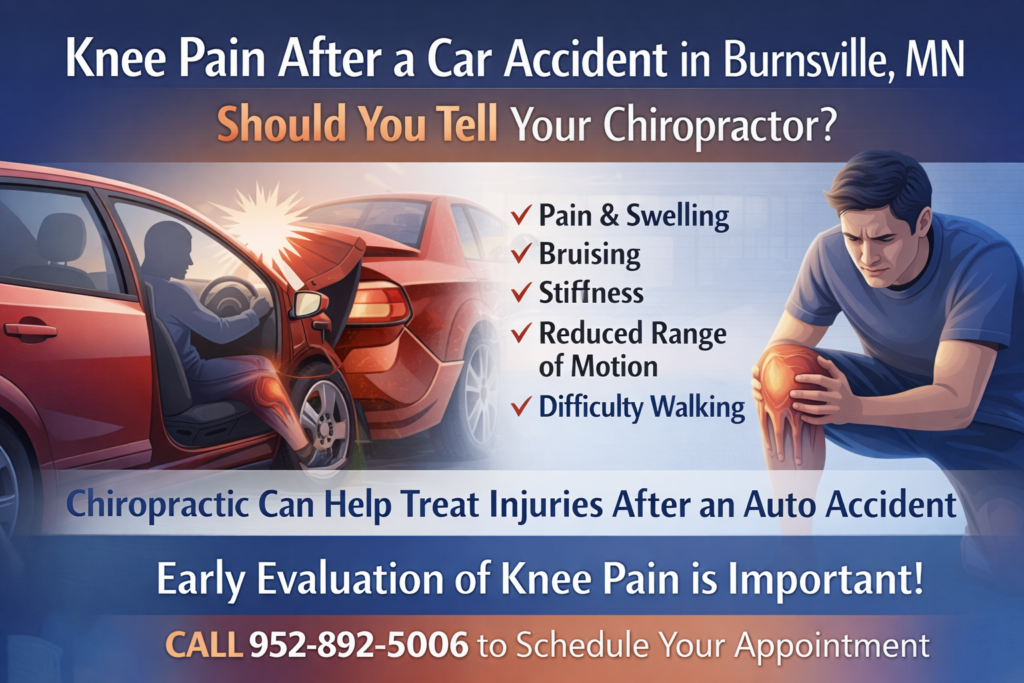
In rear-end collisions, one of the most common overlooked injuries involves the knee. This often happens when a person’s knee is pushed into the dashboard at the moment of impact, especially if they were stopped at a red light or in traffic. Even if you do not clearly remember your knee hitting the dashboard, symptoms can still develop. These may include swelling, bruising, stiffness, a slowed or altered walking pattern, and painful or limited range of motion, especially with knee extension.
The good news is that knee injuries from car accidents are often very treatable with conservative chiropractic care. In many cases, the knee can be evaluated and treated alongside spinal injuries during regular chiropractic visits. Chiropractors may use manual techniques and/or instrument-assisted methods to help improve joint motion, reduce joint compression, mobilize stiff ligaments, and support the healing process.
If the knee is very swollen or acutely injured, it may not be adjusted right away. Applying motion to a severely inflamed joint too early can be uncomfortable and may slow healing. When it is safe to do so, your chiropractor will choose the most appropriate technique to address knee joint dysfunction and help reduce pain and stiffness.
If chiropractic care does not produce the expected improvement, Dr. Rankin may refer you for imaging, such as X-rays or other studies, to rule out more serious injury. Depending on the findings, additional medical care may be recommended. Fortunately, most knee pain related to rear-end collisions responds well to conservative treatment and at-home strengthening or rehabilitation exercises.
Healing time varies depending on the severity of the injury, but in many cases, knee pain improves within a similar timeframe as neck and back soft tissue injuries. The most important thing is to report your knee symptoms as soon as possible. Ignoring knee pain can allow a minor injury to become a long-term problem.
No matter how small it may seem, your knee pain is just as important as your neck and back injuries. Always tell your chiropractor or medical provider about all symptoms after a car accident so nothing is missed. Your future health — and your future self — will thank you.
If you’ve been injured in a rear-end collision and live in Burnsville, Apple Valley, Eagan, Savage, Lakeville, Bloomington, or nearby areas, call South Metro Wellness Clinic to schedule an evaluation and consultation with Dr. Christine Rankin, DC, at 952-892-5006. A thorough exam can help identify and treat all injuries related to your accident, including knee pain, so you can recover with confidence.
 Español de México
  English